Caught in the Crossfire: Two New Chinese Decrees Raise the Stakes on Sanctions Compliance
In Short
The Situation: China's State Council recently issued two regulations with immediate effect that significantly expand China's countersanctions framework: the Regulations on Industrial and Supply Chain Security (Decree No. 834) and the Regulations on Countering Foreign Improper Extraterritorial Jurisdiction (Decree No. 835).
The Result: Decree No. 834 establishes an interagency mechanism to monitor industrial and supply-chain security. Foreign entities that disrupt supply to Chinese companies or that implement discriminatory measures causing substantial harm face investigation and countermeasures, including but not limited to trade restrictions, investment bans, and visa suspensions. The decree also prohibits certain undefined supply-chain investigations within China that are in violation of Chinese laws and regulations. Decree No. 835 authorizes the Ministry of Justice to identify "improper foreign extraterritorial measures" and issue "non-enforcement orders." Violators face placement on a Malicious Entity List and countermeasures including but not limited to asset freezes, data-transfer prohibitions, and fines.
Looking Ahead: Neither regulation includes detailed implementing guidelines, and key terms remain undefined, leaving significant enforcement discretions. Companies with China-facing operations should promptly assess their exposure, particularly regarding export-control compliance and supply-chain management.
Background
China's countermeasure system has developed incrementally since 2020 in response to export controls, sanctions, and unilateral trade measures that restrict or cut off supply to China. The system includes: (i) the 2020 Unreliable Entity List ("UEL") Provisions published by the Ministry of Commerce ("MOFCOM"); (ii) the 2021 Blocking Rules issued by the MOFCOM (see Jones Day's publication China Releases Rules to Address Extra-Territorial Applications of Foreign Laws); (iii) the 2021 Anti-Foreign Sanctions Law ("AFSL") by the Standing Committee of National People's Congress, seated at the top of the legal hierarchy (see Jones Day's China Enacts Law to Counter Foreign Sanctions); and (iv) the 2025 AFSL Implementing Regulations (State Council Decree No. 803). The two 2026 decrees consolidate and expand China's countermeasure toolkit under the existing regulations by, among other things, introducing an interagency mechanism to monitor supply-chain security, authorizing the Ministry of Justice ("MOJ") to investigate and designate improper extraterritorial foreign measures, and introducing criminal liability for violations.
Highlights of the Two Decrees
- Assertion of extraterritorial jurisdiction (Article 4 of Decree No. 835): Decree No. 835 expressly affirms China's right to exercise extraterritorial jurisdiction over conduct that has an "appropriate connection" with China, based on Chinese law, international treaties, or the principle of reciprocity. Although other Chinese laws have their own extraterritorial reach, Article 4 is the clearest signal yet that China intends to build a long-arm jurisdiction specifically to counter foreign sanctions and due-diligence regimes. Where both China and a foreign state claim jurisdiction over the same conduct, Article 4 contemplates resolution through treaty negotiation, diplomatic channels, or consultation between competent authorities.
- Identification of improper foreign extraterritorial measures (Article 6 of Decree No. 835): The MOJ, acting through an interagency mechanism, will assess whether a foreign measure constitutes improper extraterritorial jurisdiction. The assessment considers the measure's conformity with international law, the strength of the nexus between the foreign state and the regulated conduct, and the harm to China's sovereignty, security, development interests, or the lawful rights of Chinese citizens and organizations. The triggering standards are broad, giving Chinese authorities substantial discretion. Entities and individuals may also petition the MOJ to initiate investigation processes to identify improper foreign extraterritorial jurisdiction.
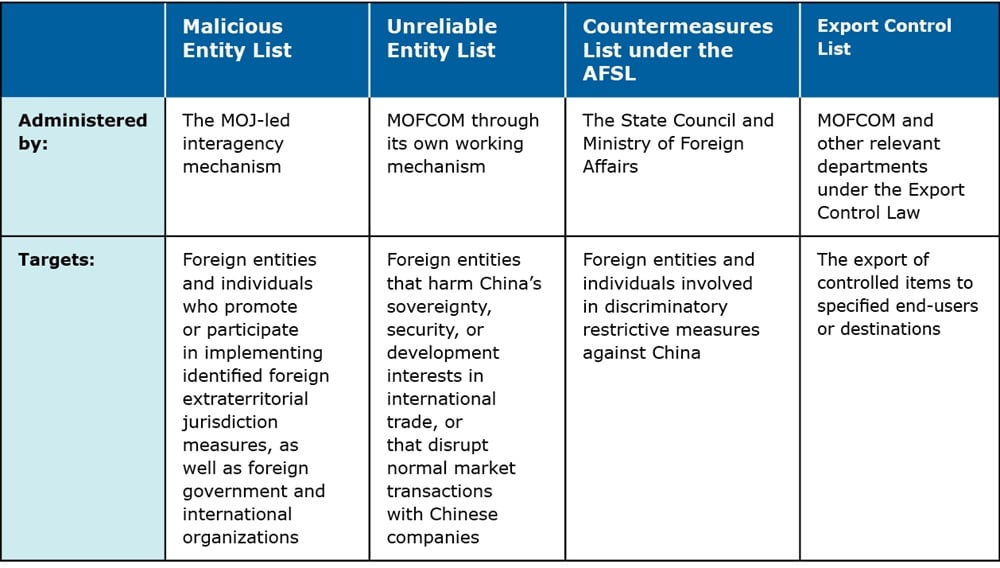
- The Malicious Entity List and piercing rules (Article 8 of Decree No. 835): Decree No. 835 authorizes a Malicious Entity List targeting foreign organizations and individuals that "promote or participate in implementing" an identified foreign measure. Countermeasures include but are not limited to asset freezes, data-transfer restrictions, visa suspensions, trade prohibitions, investment restrictions, and fines—nine enumerated categories in total. Critically, these measures may extend to entities "actually controlled" by, or established or operated by, a listed party—a corporate piercing provision. Unlike the 50% rule of the U.S. Office of Foreign Assets Control, which triggers automatically based on ownership, this decree's piercing test turns on "actual control," suggesting that Chinese sanctions will penetrate corporate structures on a case-by-case basis rather than through a fixed ownership threshold. Although China's various trade-restriction lists target different entities and activities, they complement each other with some overlaps, as illustrated by the table below.
- Prohibition orders (Article 13 of Decree No. 835): Decree No. 835 authorizes the MOJ to issue prohibition orders or non-enforcement orders directing all persons in China not to comply with identified foreign measures. Violations can trigger penalties affecting local assets, procurement, trade, entry into China, and data transfers. This expands the prohibition mechanism under the 2021 Blocking Rules issued by MOFCOM. The decree also adds new investigative tools, including on-site inspections and the power to review and copy relevant materials.
- Private right of action (Article 14 of Decree No. 835): Decree No. 835 creates a private right of action enabling Chinese parties harmed by another party's compliance with a foreign extraterritorial measure to sue for damages in Chinese courts. This parallels existing private-action provisions under the AFSL and the 2021 Blocking Rules. An unresolved question is whether Article 4's assertion of regulatory extraterritorial jurisdiction alone confers court jurisdiction over such claims, or whether plaintiffs must separately meet jurisdictional requirements under the Civil Procedure Law (e.g., through the defendant's assets in China or a "suitable connection" to China). The decree does not address this issue, and the reach of the private right of action against extraterritorial defendants remains an open question.
- Restrictions on information collection (Article 13 of Decree No. 834): Decree No. 834 restricts any organization or individual from conducting supply-chain-related "investigations and other information collection activities" within China in violation of Chinese laws, administrative regulations, departmental rules, and relevant state provisions. Violations are subject to enforcement by the relevant authorities. The scope of restricted "information collection activities" is not precisely defined. However, the statutory qualifier—"in violation of Chinese laws, administrative regulations, departmental rules, and relevant state provisions"—and the legislative history suggest that the restriction is primarily aimed at malicious collection of sensitive information, such as gathering supply-chain data for purposes of foreign sanctions designation.
- Criminal liability (Article 18 of Decree No. 835): Violations constituting a crime are subject to criminal prosecution. Neither the AFSL nor the 2021 Blocking Rules contain an express criminal liability provision. Decree No. 835 now introduces this possibility, raising the stakes for entities and individuals that violate prohibition orders, fail to execute countermeasures, or otherwise contravene the decree's requirements. The specific criminal offenses and thresholds remain to be clarified through prosecutorial and judicial practice.
Enforcement Outlook
Although both regulations are effective immediately, it will take time for the interagency mechanisms to become fully operational. Multiple ministries and commissions are tasked with implementing the supply-chain security regulation in accordance with their respective mandates. The ministries and commissions include those overseeing foreign affairs, development and reform, industry and information technology, public security, state security, justice, finance, natural resources, transport, agriculture and rural affairs, commerce, financial regulation, customs, market regulation, cyberspace administration, and other relevant government bodies.
Key terms remain undefined, leaving significant enforcement discretion. This includes questions of what constitutes "interrupting normal transactions," the boundaries of "improper extraterritorial jurisdiction," the threshold for an "appropriate connection" triggering Chinese long-arm jurisdiction, and the scope of "promoting" improper foreign extraterritorial measures for the Malicious Entity List.
China's countersanctions enforcement has shifted from being largely declaratory to becoming increasingly operational but calculated. UEL enforcement increased sharply in 2025, with 67 designations compared to only three in 2024. AFSL enforcement has also intensified, with more than 100 organizations and individuals designated in 2025 across the Countermeasures List and UEL. MOFCOM has invoked its power under the Blocking Rules for the first time on May 2, 2026, issuing a blocking order prohibiting entities and individuals from recognizing, enforcing, and complying with U.S. sanctions on five Chinese companies. Despite the ambiguities about the details of implementation, the strategic direction is unmistakable: the two decrees signal China's determination to transform its countersanctions apparatus from a largely latent deterrent system into a more aggressive and operational system capable of deterring and mitigating the impact of foreign sanctions actions. At the same time, China appears to be calibrating its approach so as not to chill legitimate commercial activities, as enforcement to date has been limited primarily to U.S. defense companies.
Four Key Takeaways
- Supply-chain decisions require careful legal analysis. Legal advice and deliberate planning are essential when assessing supply-chain adjustments, because relocating supply chains out of China or terminating supply to Chinese customers may trigger an investigation, particularly in strategic sectors or industries. To avoid misunderstandings by the authorities, it may be advisable to refrain from issuing public and broad statements when making supply-chain adjustments.
- Global compliance requires careful assessments of conflict-of-laws risk. Foreign sanctions, export controls, and due-diligence mandates may now require conduct that Chinese law potentially prohibits. The private right of action compounds this risk: injured Chinese counterparties can sue directly, meaning that enforcement pressure no longer comes exclusively from the Chinese government.
- Interplay with export controls, antitrust, anti-corruption, and data compliance requires strategic thinking and planning. Companies engaged in international operations may face increased scrutiny under multiple intertwined areas of law and may have to navigate complex legal requirements.
- Act now despite ambiguity. The immediate effective date and the enforcement surge counsel against a wait-and-see approach. Companies should map their conflict-of-laws exposure, review global compliance policies, and develop contingency strategies for designation scenarios. This includes identifying potential triggers (e.g., compliance with new foreign sanctions rounds, participation in supply chain due-diligence audits, and responding to foreign-government information requests) and understanding the range of options and consequences with an eye toward minimizing risk exposure.