Mexico Unlocks Private Investment in Strategic Infrastructure
In Short
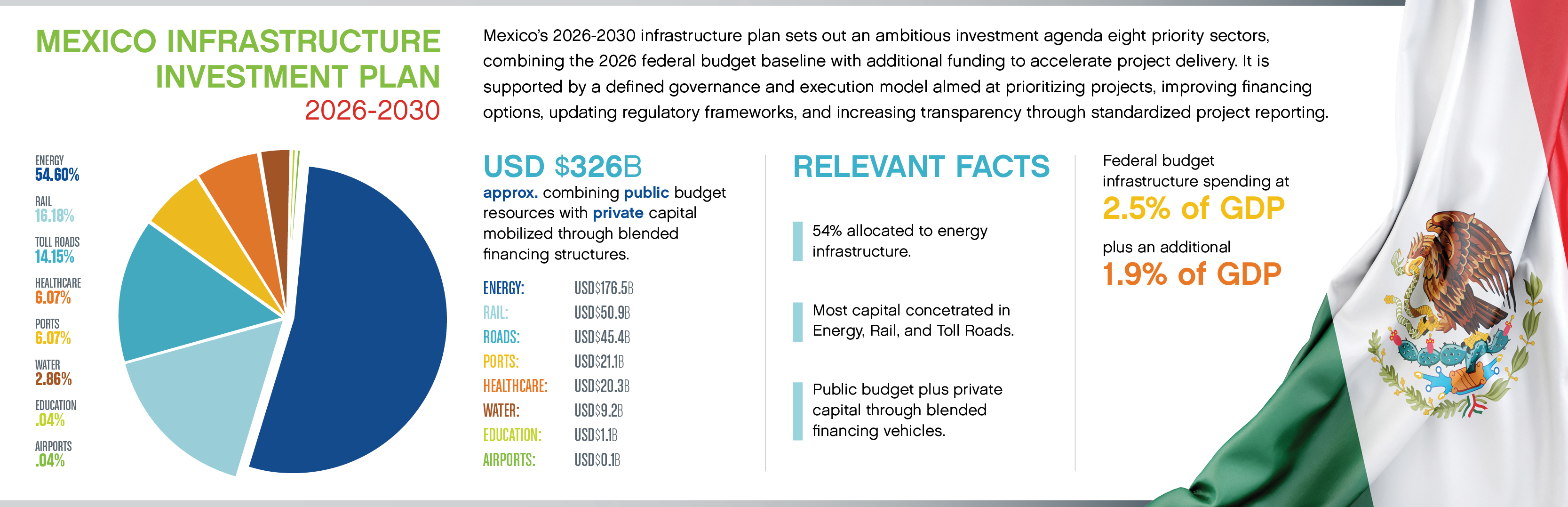
The Background: Mexico's infrastructure legal framework had not been meaningfully updated since the Law on Public-Private Partnerships (Ley de Asociaciones Público Privadas) of 2012—a rigid procurement model that lacked the flexibility to attract sophisticated private and institutional capital at scale. In February 2026, President Claudia Sheinbaum unveiled the Investment Plan for Infrastructure for Development with Wellbeing 2026–2030, targeting approximately $314.8 billion in investment across energy, transport, water, and social infrastructure.
The Result: On April 9, 2026, the Law for the Promotion of Investment in Strategic Infrastructure for Development with Well-being (Ley para el Fomento de la Inversión en Infraestructura Estratégica para el Desarrollo con Bienestar) (the "Law") was published in the Federal Official Gazette (Diario Oficial de la Federación). The Law regulates investment mechanisms that the state provides or promotes for strategic projects and their procurement.
Looking Ahead: The Law's practical impact will depend on secondary regulation. The Federal Executive has 180 days to issue implementing regulations, and the Ministry of Finance has the same period to publish eligibility and financing guidelines.
The Policy Context: Why This Law, Why Now
In February 2026, the federal government presented the Investment Plan for Infrastructure for Development with Wellbeing 2026–2030, targeting approximately US$314.8 billion in infrastructure investment across energy (54%), land connectivity (30%), maritime and air connectivity (6.5%), and social infrastructure (9.5%). The Law provides the institutional and contractual framework to implement this Plan.
The Law does not replace the Public-Private Partnerships Law (Ley de Asociaciones Público Privadas) or any other existing framework—both regimes coexist. Practitioners should evaluate on a project-by-project basis which regime best serves their client. The Law introduces a specialized regime that expressly contemplates securitization of infrastructure assets, flexible co-investment structures, and contractual arrangements designed for sophisticated private and institutional capital participation.
The Law expressly states that it does not constitute an autonomous source of budgetary allocation, debt authorization, or guarantee issuance. All mechanisms operate within existing constitutional and legal constraints, in full compliance with Mexico's fiscal responsibility framework.
Governance and Decision-Making: Who Controls the Process
The Law's institutional architecture concentrates significant decision-making power in a small number of actors. Understanding how that power flows is as important as understanding the legal text itself.
At the center is the Strategic Planning Council for Investment in Infrastructure (Consejo de Planeación Estratégica para la Inversión en Infraestructura) (the "Council"), a permanent advisory body chaired by the Executive Power, with the Ministry of Finance (Secretaría de Hacienda y Crédito Público) as alternate chair. The Council determines which projects are eligible, which may access special purpose vehicles and their associated benefits, and which mixed participation scheme structure is appropriate for each project. It also approves a national investment strategy and coordinates across agencies to ensure timely execution.
The Ministry of Finance (Secretaría de Hacienda y Crédito Público) plays a dual role: as alternate chair of the Council and as the authority responsible for issuing guidelines that define eligibility criteria, financing rules, and project evaluation methodologies. The National Bank of Public Works and Services (Banco Nacional de Obras y Servicios Públicos) and the National Infrastructure Fund (Fideicomiso Fondo Nacional de Infraestructura) are expressly contemplated as primary financial vehicles through which the state will structure, co-invest in, and provide credit support for approved projects. At the sectoral level, the Federal Electricity Commission (Comisión Federal de Electricidad), Pemex (Petróleos Mexicanos), and the Ministry of Infrastructure, Communications and Transport (Secretaría de Infraestructura, Comunicaciones y Transportes) have authority to sponsor and lead projects in energy, transport, and connectivity.
Two features of this governance structure are critical for private sector participants. First, the Council's eligibility and precedence determinations are expressly excluded from administrative challenge—neither annulment proceedings nor amparo are available to contest an adverse decision. Second, the Council's recommendations are non-binding on implementing agencies, and the final decision to execute a project remains with the sponsoring agency.
Mixed Participation Schemes: A More Flexible Model for Co-Investment
The Law establishes two modalities of mixed participation schemes (Esquemas de Participación Mixta).
Long-Term Contracting (Contratación de Largo Plazo) allows private sector participation in financing, design, construction, equipment, operation, conservation, maintenance, rehabilitation, or modernization of infrastructure in exchange for periodic payments or other investment recovery mechanisms linked to project performance. Assets must be transferred to the state upon contract expiration.
Mixed Investment (Inversión Mixta) allows public and private sectors to participate jointly in the capital or patrimony of a project, directly or indirectly, sharing risks, costs, investments, and benefits in proportion to their participation interests. The public sector may contribute through cash or in-kind contributions, rights of use and exploitation, concessions, permits or authorizations, movable or immovable assets, or intangible rights. The Law requires contracts to establish optimal risk distribution across design, construction, operation, financial, demand, regulatory, environmental, and social risks.
Both modalities are designed to coexist with sector-specific legislation. Energy sector projects remain governed by the Electricity Sector Law (Ley del Sector Eléctrico) and the Hydrocarbons Sector Law (Ley del Sector de Hidrocarburos). Projects involving foreign capital remain subject to the Foreign Investment Law (Ley de Inversión Extranjera).
Special Purpose Vehicles: Infrastructure Meets the Capital Markets
Special purpose vehicles (Vehículos de Propósito Específico) represent the Law's most significant structural innovation. They may be established as private or public trusts, or as Mexican commercial entities, offering the flexibility to align each transaction with its specific legal and tax considerations.
Special purpose vehicles are designed to facilitate investment in and financing of projects. Their investment regimes may include acquisition of equity interests and securities aimed at promoting energy and infrastructure projects. They are expressly authorized to issue securities under the Securities Market Law (Ley del Mercado de Valores).
As a result, assets such as highways, ports, or water treatment plants may now be financed through public bond issuances, tapping into capital from pension funds, insurance companies, and other institutional investors through vehicles such as CKDs, CERPIs, and FIBRAs E.
Project assets and cash flows may be pledged as collateral, providing a security package for lenders and bondholders. Creditors hold intervention rights upon project default to ensure investment continuity.
Existing public funds and trusts, including the National Infrastructure Fund (Fideicomiso Fondo Nacional de Infraestructura), may participate in or constitute special purpose vehicles.
The Strategic Investment Contract: The Central Legal Instrument
For each project, the chosen participation modality, the relationship between the parties, and risk distribution are formalized in a strategic investment contract (Contrato de Inversión Estratégica)—the Law's central legal instrument. Its key features include:
Term. Contracts run for a minimum of four years and a maximum of 40 years, including extensions.
Assignment and collateral. Contract rights may be assigned or pledged as collateral to third parties, subject to prior authorization from the contracting agency. Such assignments may serve as a direct payment source for special purpose vehicles.
Economic equilibrium. The Law recognizes the right to request contract revision when an act of authority substantially increases execution costs and threatens financial viability. This right is subject to strict conditions: the triggering act must occur after submission of economic proposals, must not have been foreseeable at adjudication, and must represent a change to the applicable legal framework. Contract modifications are limited to four grounds: infrastructure improvement, environmental protection, unforeseeable supervening causes, and restoration of economic equilibrium.
The Five-Stage Project Lifecycle: What It Means in Practice
The process for accessing a project under the Law follows a special contracting procedure structured in five successive stages:
- Presentation. The sponsoring agency submits the project to the Council, accompanied by feasibility studies demonstrating technical, legal, economic, and financial viability, as well as an economic and patrimonial valuation of the infrastructure assets. The quality of this documentation determines how the project advances through subsequent stages. Given that the Council's decisions are non-appealable, there is no procedural remedy for a poorly prepared submission.
- Eligibility. The Council examines the project against five criteria: technical viability, legal viability, investment estimates and funding sources, economic and financial viability, and social benefits and sustainability. A favorable determination grants the project "eligible" status, unlocking access to the Law's mechanisms.
- Precedence. The Council analyzes eligible projects and determines their precedence, approving the specific special purpose vehicle and the mixed participation scheme modality appropriate for each project. At this stage, the financial and legal architecture of the transaction is formally defined.
- Tender. The sponsoring agency convenes a competitive public tender under the principles of legality, free competition, objectivity, and transparency. Prior to the formal tender, agencies may hold informational meetings with interested market participants. Direct award and invitation to at least three parties are permitted in specific enumerated circumstances, including natural monopoly situations, national security considerations, and strategic technology alliances.
- Contract execution. The strategic investment contract is formalized with the winning bidder, at which point project timelines and contractual obligations commence.
Budget Reforms: A Stronger Foundation for Bankability
Alongside the Law, amendments to the Federal Budget and Fiscal Responsibility Law (Ley Federal de Presupuesto y Responsabilidad Hacendaria) create a more stable and predictable environment for infrastructure investment. These changes are directly relevant to project bankability and to financiers' and investors' assessment of sovereign risk.
Three changes are particularly significant:
- First, when revenue shortfalls require spending adjustments, the state must endeavor not to affect expenditures linked to strategic infrastructure projects. The term "endeavor" introduces discretion, but this protection represents an improvement over the existing framework.
- Second, multi-year commitments derived from strategic investment contracts must be disclosed in a dedicated chapter of each annual federal budget, providing forward visibility into government payment obligations.
- Third, the Ministry of Finance (Secretaría de Hacienda y Crédito Público) may authorize procurement processes before full budgetary sufficiency is confirmed, provided sufficiency is secured prior to award.
A Defining Moment for Mexico's Infrastructure Market
The Law establishes a specialized legal regime for infrastructure investment that did not previously exist in Mexico's federal framework. The combination of capital markets access through special purpose vehicles, flexible co-investment structures, protected budget commitments, and a specialized contracting regime represents a significant advancement in Mexico's infrastructure investment landscape.
The Regulations and Ministry of Finance (Secretaría de Hacienda y Crédito Público) guidelines due within 180 days of the Law's publication will establish the operational framework governing implementation. The Strategic Planning Council (Consejo de Planeación Estratégica para la Inversión en Infraestructura) must be constituted within 120 days of publication.
The initial tenders conducted under this Law will set key precedents and shape market practices for years to come. Investors, developers, financiers, and operators that engage early in the regulatory process—through active participation in consultations, close coordination with sponsoring agencies, and involvement in structuring first-generation projects—will be best positioned to capitalize on the opportunities this new framework creates.
Five Key Takeaways
- A new regime, not a replacement. The Law coexists with the Public-Private Partnerships Law and other existing frameworks. Practitioners should evaluate on a project-by-project basis which regime—or combination of regimes—best serves their objectives.
- Securitization of infrastructure is the central innovation. Special purpose vehicles may issue trust stock certificates (certificados bursátiles fiduciarios) and analogous instruments, opening infrastructure projects to pension funds, insurers, and institutional investors through capital market vehicles such as CKDs, CERPIs, and FIBRAs E—moving well beyond traditional bank financing.
- Mixed participation schemes redefine public-private collaboration. Unlike traditional public-private partnerships, the public sector may participate as a majority, equal, or minority partner with no fixed percentage requirements. This can occur through either long-term contracting or mixed investment structures that permit genuine joint equity participation.
- Strategic investment contracts introduce meaningful but carefully bounded investor protections. Contracts running four to 40 years include an express right to seek revision when an act of authority substantially increases execution costs and threatens financial viability. This right is subject to strict conditions: the triggering act must occur after submission of economic proposals; must not have been foreseeable at adjudication; and must represent a change to the applicable legal framework. Contract modifications are further limited to four specific grounds: infrastructure improvement, environmental protection, unforeseeable supervening causes, and restoration of economic equilibrium.
- Secondary regulation defines the real timeline. The Law's operative provisions on project eligibility, special purpose vehicle structuring, and tender procedures will not be fully defined until the regulations and Ministry of Finance guidelines are published—due within 180 days of the Law's publication. The Council's eligibility determinations are non-appealable, and its recommendations are non-binding. Early engagement in the regulatory drafting process remains the most strategic approach.