Decree 2026-741: France Takes First Step in Modernizing Arbitration Law
In Short
The Background: France's arbitration framework, last revised in 2011, has just been amended by Decree No. 2026-741, which mostly implements proposals that achieved broad consensus during public consultation.
The Result: The Decree introduces targeted reforms to the Civil Procedure Code, including a new duty of proportionality, expanded powers for the supporting judge (juge d'appui) to grant provisional enforceability to interim measures, a standalone recognition proceedings distinct from exequatur, authority for tribunals to liquidate astreintes (daily penalties), electronic award-making, and tailored procedures for challenges to international awards. The amendments take effect on January 1, 2027, subject to transitional rules.
Looking Ahead: This Decree represents only the first phase of a three-stage reform process announced by the Ministry of Justice in April 2025. A second decree addressing more contested issues is expected, followed by legislation establishing a standalone French arbitration code.
On August 7, 2026, France published Decree No. 2026-741 (the "Decree"), marking the first substantive reform of French arbitration law since 2011. The Decree amends provisions of the Civil Procedure Code governing both domestic and international arbitration, with the stated aim of modernizing and clarifying arbitral proceedings to enhance France's attraction as a leading arbitration hub. Key reforms include the introduction of an express duty of proportionality, expanded powers for the juge d'appui to confer provisional enforceability on interim measures and to order third-party document production, a new standalone recognition proceedings for arbitral awards, authority for arbitral tribunals to liquidate astreintes (daily penalties) by award, and modernized rules permitting electronic awards. The Decree also refines the exequatur regime, provides a statutory framework for multi-contract claims, updates the definition of international arbitration, and introduces tailored procedures for challenges to international awards that accommodate foreign-language documents and confidentiality concerns. This commentary examines each of these developments.
France Amends its Arbitration Law for the First Time in 15 Years
Decree No. 2026-741 of August 6, 2026, on various measures to clarify and modernize arbitral procedure (the "Decree") was published in the Journal officiel on August 7, 2026. It amends provisions of the French Civil Procedure Code ("CPC") governing both domestic and international arbitration.
The Decree is a targeted modernization rather than a comprehensive overhaul. It represents the first stage of the three-part reform announced by the Minister of Justice: an initial decree implementing proposals that attracted broad support during public consultation; a second decree addressing more contested matters; and, ultimately, legislation establishing a standalone arbitration code.
This commentary highlights the principal changes, which generally take effect on January 1, 2027, subject to the transitional rules summarized below.
A New Duty of Proportionality
Among the Decree's most notable contributions is an express duty of proportionality in the conduct of arbitral proceedings. The third paragraph of Article 1464 of the CPC–which governs the duties of parties and arbitrators–now requires them to "endeavor to tailor the procedure to the complexity and stakes of the dispute."
The aim is to calibrate procedural sophistication–including the number of arbitrators and hearings and the duration of the arbitration–to the complexity and stakes–financial or otherwise–of the dispute.
This duty echoes the efficiency requirements found in various institutional rules, including Article 23 of the 2026 Rules of Arbitration of the International Chamber of Commerce ("ICC")–a principle that arbitrators, counsel, and parties widely recognize, even where not expressly codified.
Expanded Role of the Supporting Judge
The Decree significantly expands the role of the juge d'appui–the judge acting in support of arbitration–beyond assisting with arbitral tribunal constitution. Two new powers are particularly significant:
First, any party may ask the juge d'appui to confer provisional enforceability on interim or conservatory measures ordered by the arbitral tribunal (amended Article 1468 of the CPC). The judge rules under the accelerated procedure on the merits and must grant the request unless enforcement would seriously prejudice a party's rights or the measure is contrary to public policy.
This new power enhances the effectiveness of interim and conservatory measures. The juge d'appui's decision takes the form of a judgment that may be appealed within 15 days of service; it does not have res judicata effect on the merits.
Second, the juge d'appui may order production of an official copy or disclosure of a deed or document held by a third party (amended Articles 1469 and 1505(5) of the CPC).
Recognition as a Distinct Action
The Decree introduces a standalone action for recognition of arbitral awards, distinct from exequatur. Recognition gives the award legal effect in France, including res judicata effect, but does not permit compulsory enforcement. Exequatur, by contrast, renders the award enforceable.
Previously, only exequatur had a specific procedural framework. The possibility of obtaining recognition of an award is now expressly provided for in new Articles 1487-1 and 1516-1 of the CPC for domestic and international arbitration, respectively.
Related amendments require any refusal of recognition or exequatur to be reasoned (amended Articles 1488 and 1517). While a challenge to the arbitral award is pending, the first president or case-management judge may now recognize the award or grant exequatur if doing so is not manifestly contrary to the applicable public-policy standard (amended Articles 1498 and 1521). Dismissal of the set aside proceedings on the merits automatically results in exequatur or, where enforcement cannot be pursued, recognition (amended Articles 1498 and 1527).
Refinements to the Exequatur Regime
The Decree removes the automatic suspensive effect of annulment proceedings and appeals in domestic arbitration. Awards are now immediately enforceable notwithstanding pending set aside proceedings. However, the judge may stay enforcement if it is likely to seriously prejudice a party's rights.
Articles 1497 and 1526 previously empowered judges to stay or modify enforcement of a domestic or international arbitral award where it could seriously prejudice a party's rights. As amended, those provisions now empower judges only to suspend enforcement; the power to tailor the manner of enforcement has been removed. That amendment was not part of the initial draft recast and accordingly has not been discussed by scholarship and practitioners in the preparatory phase.
It remains to be seen whether courts would interpret these amended provisions as empowering them to amend the enforcement. However, the removal of this power in the amended drafting of these provisions is not promising.
Amended Articles 1500 and 1523 change the event triggering the time limit for appealing an order refusing recognition or exequatur. The period now runs from notification of the order rather than formal service.
This change prevents the appeal period from remaining open indefinitely when the order is never formally served.
Multi-Contract claims in a Single Arbitration
Many institutional rules already permit multiple claims arising from several contracts to be submitted in a single arbitration. Article 10 of the ICC Rules is one example.
The new Article 1462-1 of the CPC now supplies a statutory framework for such claims, irrespective of whether the applicable rules address the issue. Where the chosen rules permit multi-contract claims, those rules govern. Otherwise, such claims may proceed together only if the arbitration agreements are compatible and no party objects.
Arbitral Tribunals May Now Liquidate Astreintes
Arbitral tribunals could already impose astreintes–a periodic financial penalty intended to compel compliance–under Article 1468 of the CPC, but liquidation had to be ordered by the enforcement judge.
The new Article 1468-1 of the CPC allows the arbitral tribunal itself, for as long as it remains seized, to liquidate an astreinte by an award.
Clarifying the Competence-Competence Principle
Article 1448 of the CPC requires a French court to decline jurisdiction over a dispute covered by an arbitration agreement unless two conditions are met: the arbitral tribunal has not yet been seized, and the agreement is manifestly void or manifestly inapplicable. In addition, the Decree provides that any contractual stipulation derogating from this rule must be express and unambiguous ("expresse et non équivoque"). The Decree now fixes the relevant date to assess the first condition: it is specified that it is to be assessed when the court is seized. Accordingly, a tribunal seized only after court proceedings have commenced has no bearing on the court's power to find the arbitration agreement manifestly void or manifestly inapplicable.
This approach avoids a race to constitute an arbitral tribunal solely to divest the state court of jurisdiction after proceedings have commenced and dispenses with the need for the court to reassess its jurisdiction while those proceedings are pending.
Defining and Digitalizing Arbitral Awards
The Decree codifies the definition of an arbitral award and modernizes the rules governing its form and filing.
The new Article 1478 of the CPC defines an award as an act by which the arbitral tribunal finally disposes, in whole or in part, of the dispute submitted to it, whether on jurisdiction, a procedural plea capable of ending the proceedings, or the merits. This formulation adopts the definition previously developed by French courts.
In addition, a decision liquidating an astreinte is expressly characterized as an award under the new Article 1468-1.
By contrast, decisions ordering interim or conservatory measures are excluded from the definition. The potential drawback–that such orders would fall outside the exequatur framework–is neutralized by the Decree's conferral of power on the supporting judge to render them enforceable, as described above.
The Decree also introduces several modernizing amendments to the rules governing arbitral awards. The new Articles 1480-1 and 1480-2 of the CPC expressly permit awards to be rendered electronically, provided their integrity and preservation are guaranteed (Article 1480-1) and that, for domestic awards, they bear a qualified electronic signature (Article 1480-2). The amended Articles 1487, 1488, 1515 and 1516 further provide that recognition or exequatur may be sought on the basis of an authenticated copy, rather than the original award.
Updated Definition of International Arbitration
Article 1504 of the CPC, which defines international arbitration, has been amended to replace the words "interests of international trade" with "international economic interests". It now reads as follows: "An arbitration is international where it involves international economic interests."
The change preserves the established economic test while avoiding the potentially narrow connotation of "trade." Internationality depends on whether the underlying transaction extends economically beyond a single State, irrespective of any foreign connecting factors such as the parties' nationality or place of business, the law applicable to the dispute or to the contract, or the seat of the arbitration.
Tailored Procedures for Challenging International Awards
The Decree adapts court proceedings concerning international awards to the practical realities of international arbitration. The new rules draw upon the procedural protocol applied by the International Commercial Chamber of the Paris Court of Appeal (subject to parties' opting in).
Under the new Article 1527-3 of the CPC, parties may submit documents in a foreign language without an accompanying translation, although the court may still require one.
Under the new Article 1527-4 of the CPC, parties, witnesses, experts, and counsel may be authorized to address the court in a foreign language, with interpretation arranged where appropriate.
Finally, under the new Article 1527-5 of the CPC, hearings remain public unless the court orders otherwise. However, at any party's request, the court may adapt both its reasoning and the publication of its decision to protect the confidentiality of the arbitration.
In practice, these measures should reduce unnecessary translation costs while affording greater protection for sensitive commercial information.
Statutory Recognition of Arbitral Institutions
The amended CPC now expressly refers to an "arbitration center" in Articles 1450, 1452–1454, 1456, and 1457 to cover any entity entrusted by the parties with administering the arbitration. This terminology replaces the more generic references to a "legal person".
The change increases the statutory visibility of arbitral institutions without altering their functions, including the appointment of arbitrators and the resolution of challenges.
Four Key Takeaways
- Proportionality is now law. The new duty to tailor procedure to the complexity and stakes of the dispute codifies a principle that is widely considered by arbitration practitioners as an unwritten rule.
- Interim relief is more effective. The juge d'appui can now confer enforceability on tribunal-ordered interim measures and compel third-party document production, enhancing the practical effectiveness of interim and evidentiary relief in France-seated arbitrations.
- Recognition is now a distinct standalone proceeding. A new standalone recognition action allows parties to secure res judicata effect for an award without seeking compulsory enforcement – useful where enforcement is premature, unnecessary, or strategically undesirable.
- Electronic awards and streamlined procedures reflect modern practice. The Decree permits electronic awards and allows foreign-language documents and oral submissions in set aside proceedings (as was already the case before the International Chamber of the Paris Court of Appeals when parties agreed to the application of that Chamber's Protocol), reducing unnecessary costs while preserving procedural integrity.
Entry into Force and Transitional Rules
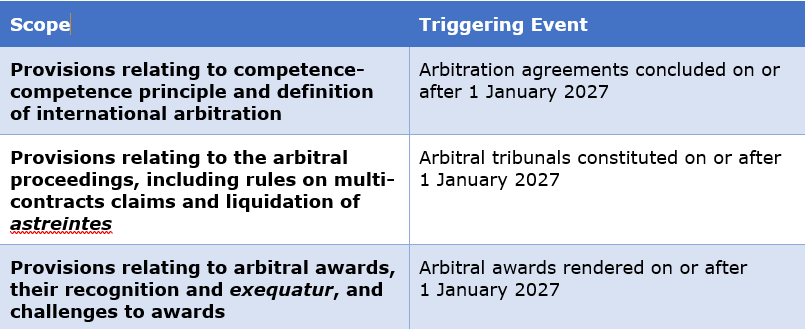
The Decree enters into force on January 1, 2027, subject to a three-track transitional regime summarized below: