U.S. Banking Agencies Propose Sweeping Overhaul of Capital Framework - Part II: Category III and IV Banking Organizations
In Short
The Situation: On March 19, 2026, the Federal Reserve, the Office of the Comptroller of the Currency ("OCC"), and the Federal Deposit Insurance Corporation ("FDIC") proposed revisions to the standardized approach for risk-weighted assets ("RWAs") applicable to Category III and IV organizations, together with conforming capital definition changes and an elective pathway into the Expanded Risk-Based Approach ("ERBA") proposed for non–Category I/II firms. For Category III/IV firms, the headline structural changes are the elimination of the Accumulated Other Consolidated Income ("AOCI") opt-out and the replacement of the flat 50% mortgage risk weight with a granular loan-to-value ("LTV") based framework.
The Bottom Line: The agencies estimate a 3.0% net decline in CET1 capital requirements for Category III and IV holding companies, reflecting a 6.1% reduction from revised RWAs partly offset by a 3.1% increase from the existing capital requirements of AOCI recognition; depository subsidiaries are projected to see a 4.7% decline. Mortgage RWAs are estimated to fall by roughly 30% under the LTV-based approach, while corporate exposures drop to 95% risk weight and "other assets" to 90%.
Looking Ahead: Comments are due June 18, 2026. The agencies also solicit views on effective date timing, the AOCI transition design, and key mortgage implementation questions, including the LTV framework and private mortgage insurance ("PMI") recognition.
SUMMARY ANALYSIS: WHAT BANKS SHOULD KNOW NOW
Mandatory AOCI recognition ends the existing opt-out, requiring inclusion of most AOCI components in CET1 capital—notably unrealized gains and losses on available-for-sale debt securities—with a five-year phase-in from 100% excluded in year one to 0% by 2032.
Residential mortgage capital would pivot to an LTV-based framework (25%–75% for non–cash-flow–dependent loans; 35%–110% for cash-flow–dependent loans), with agencies estimating roughly a 30% reduction in mortgage RWAs. Marketing service agreements ("MSAs") would carry a uniform 250% risk weight; corporate exposures drop to 95% and "other assets" to 90%, while a single 40% credit conversion factor ("CCF") replaces maturity-based CCFs, materially increasing capital requirements for shorter-term commitments.
An elective path into the ERBA could benefit approximately three holding companies (3%–7% capital reduction), though election entails the Standardized Approach for Counterparty Credit Risk ("SA-CCR"), operational risk capitalization, and permanent AOCI recognition.
EXPANDED ANALYSIS
Mandatory AOCI Recognition
The proposal would require Category III and IV organizations to include most AOCI elements in CET1 capital—except gains and losses on cash-flow hedges where the hedged item is not at fair value—aligning these firms with Category I and II treatment. All net unrealized gains and losses on available-for-sale debt securities, including those from benchmark rate fluctuations, would flow through to CET1.
Key points on AOCI recognition:
-
The agencies view the proposal as increasing transparency; that is, matching capital requirements more closely to current market conditions by extending the AOCI recognition requirement from Category I and II firms to the next tier of institutions.
-
The agencies acknowledge the proposal will increase volatility in capital ratios but note that Category III and IV organizations have the tools and market access to manage it.
-
Since 2015, aggregate security-related AOCI at Category III/IV holding companies has ranged from an unrealized gain of $16 billion to an unrealized loss of $112 billion. Using quarterly FR Y-9C data (1996 Q1–2025 Q3), the agencies estimate a long-run average 1% increase to CET1 requirements from AOCI—the principal offset against the 6.1% RWA-driven reduction, yielding the net 3.0% decline for holding companies and 4.7% decline for depository subsidiaries.
The five-year phase-in applies to firms that previously opted out. Those firms that already opt in should see few changes. The AOCI adjustment amount is the sum of:
-
Net unrealized gains or losses on available-for-sale securities;
-
Accumulated net gains or losses on cash-flow hedges; and
-
Certain amounts attributed to defined benefit postretirement plans resulting from initial adoption.
The agencies seek comment on whether the five-year structure is appropriately designed, whether early full recognition should be optional for firms with positive AOCI, and whether firms electing the ERBA should be subject to the same or different transition provisions.
Table 1: AOCI Transition Schedule (Assumes January 1, 2027, Effective Date)
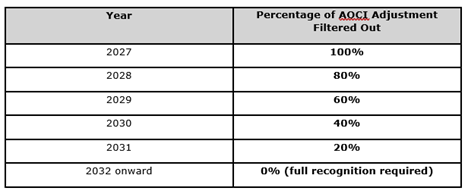
Notes: Applies to Category III/IV firms that previously elected the AOCI opt-out; agencies seek comment on duration and whether to allow optional early full recognition.
Residential Mortgage Risk Weights Under the Revised Standardized Approach
The proposal replaces the current flat 50% risk weight for residential mortgage exposures with an LTV-based approach.
Key parameters of the new framework:
-
For exposures not dependent on the cash flows of the underlying real estate, risk weights would range from 25% to 75%.
-
For cash-flow–dependent exposures, risk weights would range from 35% to 110%.
-
Data from a 2023 special collection indicate that approximately 97% of residential exposures are not cash-flow dependent, suggesting the vast majority of portfolios would fall within the lower risk-weight bands.
-
Mortgage RWAs are estimated to decrease by approximately 29.8% for covered depository institutions and 4% for covered holding companies, a significant driver of the projected net CET1 relief.
The agencies seek comment on LTV calculation mechanics, cash-flow-dependency classification (including whether an owner-occupancy-based alternative is preferable), and whether PMI should be explicitly recognized in LTVs, potentially at 50% of value to account for stress uncertainty. The mortgage framework interacts with other recalibrations—such as reduced corporate and "other assets" risk weights and revised CCFs—which may partially offset or amplify mortgage-driven RWA changes depending on a given banking organization's holdings.
Mortgage Servicing Assets, Securitization, and Off-Balance Sheet Exposures
Key changes across the mortgage ecosystem and off-balance sheet exposures:
-
Mortgage Servicing Assets. The threshold-based CET1 deduction would be replaced by a uniform 250% risk weight for all MSAs. The agencies suggest this could promote bank participation in mortgage origination and servicing, while seeking comment on calibration and concentration limits.
-
Treatment would align with the ERBA (estimated 18% RWA reduction), with floors of 15% for securitizations and 100% for resecuritizations.
-
Off-Balance Sheet Commitments. Commitments that are not classified as "unconditionally cancelable" would see credit conversion factors shift from the current 20% (for commitments with a maturity under one year) / 50% (for commitments with a maturity over one year) to a single 40% CCF, which the agencies estimate will double shorter-term exposure and increase RWAs for unused commitments under one year by approximately 90%. An example of such a commitment, from SAP, is a contractual arrangement that allows a bank to extend credit or purchase assets but does not obligate the bank to do so. The agencies note that Category III and IV firms have a greater proportion of such commitments, making this change particularly material for these firms.
Optional Election of the ERBA
Category III and IV organizations may elect the ERBA. Key dimensions of the election:
-
Approximately three Category III or IV holding companies would see a 3%–7% reduction; approximately one-third of firms below Category IV could see 5%–10% reductions, though only a small number might exceed 10%.
-
Election entails SA-CCR, operational risk capitalization, and mandatory AOCI recognition—which would remain permanent even if the firm subsequently switches back to the standardized approach.
-
Additional CVA requirements are significantly offset by reductions in market RWAs for smaller firms, but operational complexity may make the framework unappealing to many smaller organizations.
-
The agencies seek comment on optionality trade-offs, adoption challenges, and switching-frequency limits.
Additional Standardized Approach Changes and Compliance Costs
Additional changes and cost considerations:
-
Corporate exposure risk weight drops from 100% to 95%; "other assets" from 100% to 90%—contributing to the estimated 1% total RWA reduction for Category III/IV holding companies, which net of the 3.1% AOCI increase produces the net 3.0% CET1 decline.
-
Certain dollar-based regulatory thresholds would be adjusted for inflation.
-
The OCC estimates approximately $764,778 in one-time implementation costs per bank—aggregate of approximately $19.1 million across 25 institutions.
-
Comments are due June 18, 2026.
Five Key Takeaways
-
The proposals represent a material net capital reduction for Category III and IV banking organizations, with an estimated 0% decline in CET1 requirements for holding companies and 4.7% for depository subsidiaries, driven primarily by the ~30% reduction in residential mortgage RWAs and lower corporate and "other assets" risk weights—partially offset by long-run AOCI recognition.
-
The elimination of the AOCI opt-out is the most consequential structural change for these firms, introducing capital ratio volatility tied to interest rate environments and requiring significant systems, governance, and disclosure adaptations during the five-year phase-in.
-
There will be "winners and losers": Firms with large, low-LTV residential mortgage portfolios will see outsized capital relief, while those with significant shorter-term off-balance sheet commitments will face a countervailing increase from the 40% CCF, and firms with large unrealized losses on AFS securities will face higher capital charges as AOCI recognition phases in.
-
The elective ERBA is projected to benefit only a small cohort of approximately three holding companies, and the permanence of AOCI recognition—even upon switching back—should weigh heavily in any election analysis.
-
Category III and IV banks should prioritize quantitative impact assessment across AOCI, mortgage portfolios, and commitments and provide data-driven feedback on transition design and mortgage implementation choices before the June 18, 2026, comment deadline.